May 17, 2013

Day 206 - May 16, 2013: St. Michaels, MD, and the anchorage in Broad Creek 

Last night was still, warm, and "one sheet" sleeping. I opened up the boat early to a welcomed warm day. We departed Solomons in still wind and total glassy waters and went out past the south end of the Calvert Cliffs. These high cliffs are eroding rapidly, exposing the layers of silt and marine artifacts that reflect millions of years of the Bay's rising and falling water levels. While the cliffs are protected for scientific study, you can walk the beaches and frequently find a shark's tooth or fossil of astounding age. We passed the ever-present crabbing boats, the Cove Point Lighthouse, and an immense offshore Navy refueling station.

The Calvert Cliffs
A super-sized crabbing boat
Offshore Navy refueling station
After crossing the Bay, we entered the Choptank River, the setting of much of Michener's book on the Chesapeake. Here, we were finally able to measure our imagination against the real river which we'll see more of tomorrow. Our destination was St. Michaels, a popular destination for boaters. It required turning north on Broad Creek, and we anchored at the very north end in a narrow, secluded, tree-lined channel. With the dinghy lowered and the bikes inside, we headed for a dinghy dock not far ahead. It turned out to be quite shallow, and after a struggle motoring through weeds, I was able to get us to a low wall just as it started to rain. Fortunately we had umbrellas and spent time waiting for the dark cloud to pass before venturing out.

St. Michaels is a small town (~1,000) that was developed in the 1770s by James Braddock, and its earliest industry was shipbuilding. During the War of 1812, its shipyards were building schooners known as Baltimore Clippers, which were fast enough to evade the British blockades. Shipbuilding declined after the war, but a very substantial oyster industry took its place.

This town has an immense Chesapeake Bay Maritime Museum, which covers 18 acres along the waterfront. It has numerous uniquely different buildings filled with displays and historical artifacts about boats, oystering, waterfowling and more. They tell the story of both the bay, the watermen, and St. Michaels. The museum has also preserved another of the screw pile lighthouses that resided at Hooper Strait. Anne and I both got a chance to try our luck at working as a waterman. I used a long handled rake on an oyster bed, and Anne pulled up a crab trap. Neither of us had any luck.

Skipjack outside museum
The art of building boats by hand
Larry raking for oysters
Anne pulling up a crab trap
We spent the entire afternoon at this great museum before a fine meal of oysters (of course), tuna, and scallops at 208 Talbot. We returned to Great Laker just in time to catch this sunset over the river.

Sunset at the Broad Creek anchorage

May 16, 2013

Day 205 - May 15, 2013: A day on Solomons Island

Solomons Island is a small 1.8 square mile fragment of land that is at the confluence of three tributaries that flow into the Patuxent River. Inhabited since colonial days, it takes its name from a Baltimore businessman, Issac Solomon, who established oyster packing factories here shortly after the Civil War. Besides being a center for fishing, crabbing, and oystering, in the 19th century the island became known for building fishing vessels. During the War of 1812, this was the departure point for American ships attacking British warships in the Chesapeake Bay. During WWII, it supported training for amphibious landing forces. Today, it attracts tourists with numerous marinas, shops, a marine museum and restaurants.

The streets are quiet and wind around older but well maintained homes. There are several restaurants and shops, a marine biological center, and an historic oyster packing plant.

Bike riding through Solomons Island
Marine biological center


Stately home facing the water
Historic oyster packing plant


This morning, because I didn't have all the tools that were needed, a marina mechanic helped me remove the stern thruster motor. We discovered the shear pin had come loose and replaced it. When we put it back together, thankfully, it ran well.

Then Anne and I biked over to see the Calvert Marine Museum. This indoor/outdoor museum allows visitors to explore the prehistoric, biological, and marine heritage of the Chesapeake Bay. Exhibits include a marsh walk, a small craft collection, and a wood-carving shop. However, the highlight for us was a tour of the Drum Point Lighthouse, an actual screw-pile lighthouse which was moved to the museum from the bay in the late 1970s. We spent the rest of the morning at the museum before coming back for lunch on Great Laker.

Calvert Marine Museum
Drum Point Lighthouse
After lunch I had a scuba diver come by and clean barnacles off all of the running gear (main propeller, rudder, bow and stern thruster propellers). This is a necessary maintenance item in salt water and was the first time it was needed during the trip. Then it was back to see more of the museum.

Restoration of a Miocene white shark
First automated clam dredging boat
We rode over to the Tiki Bar for refreshments and then to Kim's Lotus Kitchen for dinner and Key lime pie. We justified the pie because we had ridden bikes and walked so much today!

May 15, 2013

Day 204 - May 14, 2013: Solomons Island, Maryland and Zahniser's Yachting Center

Nature can be incredibly still at night, and away from city noise with no wind and just a sliver of a moon, we both slept extremely well. Early in the morning, we reluctantly departed this area, started down the St. Mary's River, went out around Point Lookout, and turned north up the bay.

Large home and grounds along the St. Mary's River
Point Lookout Light
After cruising north and entering the Patuxent River, we passed the Patuxent River Naval Air Systems Command, which hosts the Naval Air Warfare Center, a test pilot school, and numerous other test range and simulated warfare capabilities. We watched as Navy jets screamed past overhead on training runs circling out over the bay. Our destination was Zahniser's Yachting Center in Solomons, Maryland.

After arriving, Anne headed for the laundromat, and I began trying to diagnose a problem with our stern thruster. This required examining the propeller underneath the swim platform in 60 degree water. Unfortunately, due to the record cold spring, this was only the second time on the trip I had a chance to get into a swim suit for the purposes of getting wet! Then, we rode bikes out around the island to get more familiar with what we would see tomorrow.


Zahniser's Yachting Center on the left
Larry checking the stern thruster prop in 60 degree water

May 14, 2013

Day 203 - May 13, 2013: St. Mary's City, MD

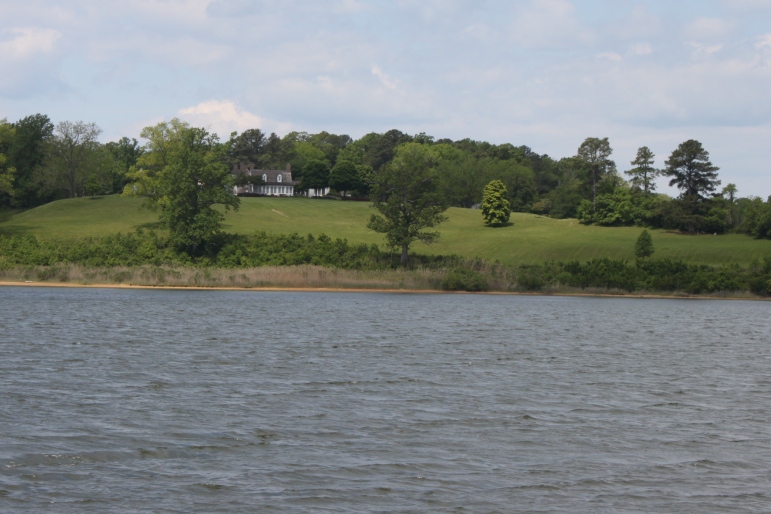
Again this morning, despite high winds and waves, we braved the Chesapeake and crossed back over to the west shore to visit St. Mary's City. It is on the St. Mary's River, a tributary of the Potomac River. We docked during the day at the St. Mary's College free dock before anchoring overnight in one of the most peaceful and scenic rivers we have seen along the Chesapeake.

St. Mary's River and college dock
Historic St. Mary's site along the river


This city, the forth oldest permanent British settlement in North America, was established in 1634 when Leonard Calvert arrived with 140 settlers in two ships named The Ark and The Dove. St. Mary's was established as the first capital of Maryland, and in the 17th century prospered due to successful tobacco farming. During this time, it became well known for its religious tolerance. The capital was moved to Annapolis in 1695, and the site where the city stood reverted to farmland.

Today, thanks to archaeologists, the town has been outlined, building locations identified, and replicas of these buildings constructed. The entire area is called Historic St Mary's City, and we toured the reconstructed city which has comprehensive explanatory signs and pictures along the route. There is also a full scale replica of The Dove, created by local artisans. This historic city is set among beautiful grassy fields and trees overlooking the river, making it a special place to visit.

Reconstructed State House built in 1676
Reconstructed lodging house


Full scale replica of The Dove
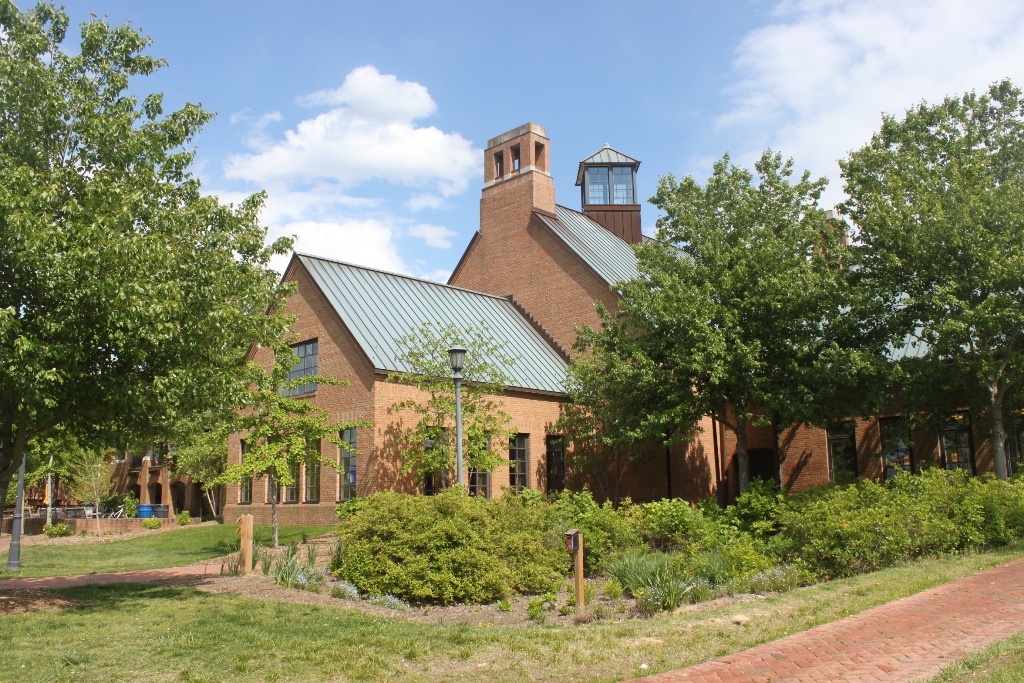
We also rode bikes through the St. Mary's College of Maryland. Established in 1840, the college shares its campus with the Historic City. Designated as a Public Honors College, there are 2,000 students and BA degrees in 22 disciplines. Students here take advantage of learning to sail on the St. Mary's River and have a nationally-ranked sailing team.

St. Mary's College Student Center

May 13, 2013

Day 202 - May 12, 2013: Tangier, MD

We moved up the Chesapeake Bay and crossed over to Tangier Island, which was one of the most unexpected and unusual places on this trip. The wind was up, and we were challenged with 2 to 4 foot waves most of the way. Coming in we were greeted by Milton Parks who runs the only marina on the island. He is 82, was in the Coast Guard, and then came back to be a waterman fishing for crabs and oysters until he retired. He was on his scooter in a black suit, just having returned from Sunday church services. The Parks Marina is basic, but Milton is full of stories that are unforgettable.

Entering Tangier among the crabbing boats
Milton Parks
Tangier Island is small (1 by 3 miles) and so isolated that inhabitants lived here for centuries with little or no contact with the surrounding world. Captain John Smith visited here in 1608 finding Indians who had been here for thousands of years. The island was first settled in 1686 by James Crockett and his sons.

People here have always lived off the sea, and there are generations of descendants with common names in the area (Pruitt, Parks and Crockett are dominant still today). Many of the people still retain an unusual accent which is kind of a cross between British and South African. They use it unless outsiders are around who find it hard to understand.

Basic services like electricity and phones came far behind those on the mainland, and today we had no cell service. The few streets are more like sidewalks, and almost everyone gets around either on foot or on a golf cart. There are about 500 people, two churches, a school, three restaurants, a museum, and a couple of gift stores. The homes are very small on very tiny lots, and the front yards frequently contain the burial sites and tombstones of the previous generations that lived there.

Main Street
A typical house and small lot
We went first to the Tangier History Museum, which although small, covered the historical events and lifestyles of the people here very well. Then we got on our bikes, even though you could walk every street on the island in a couple of hours, and enjoyed this place frozen in time.

Tangier History Museum ($3.00)

These relatives will not be forgotten!


There are tourist boats that come over daily, and the passengers scurry around the streets for an hour or two and then disappear back onto the boats. While talking to Milton Parks, he said that he could not understand why tourists were coming to Tangier and that some day he would get on one of those tours to find out! Despite the hilariousness of the remark, it reflects how much these inhabitants may be out of touch with the rest of America.

To our surprise, there was another American Tug named "Slo - Gin" here when we arrived, and we spent some time later in the day getting to know Joe and Ginny who live in St. Petersburg. They invited us over for a glass of wine, and we had a great time together.

Great Laker and Slo - Gin
Anne with Joe and Ginny


Day 201 - May 11, 2013: Our second day at Dozier's Regatta Point Yachting Center

Today was the perfect day to relax. We caught up on some reading this morning, and I spent some time removing rust from the bimini top rails, and Anne continued her research to determine our itinerary for the Chesapeake Bay.

After lunch, Waterway Guide organized a blindfolded dinghy race. The purpose is to navigate a course in the least time with one person driving with the blindfold on and the other person giving voice commands to navigate the course. The race was conducted in one of the marina fairways, and you had to go up about 50 yards, around a buoy, and back.

Ted Stehle in charge of the race
Loopers waiting to compete

This race is more difficult than you might imagine, as steering an outboard with the handle behind you is counterintuitive: pushing the handle left causes the dinghy to go right and visa versa. When commands don't lead to the proper result, frustration ensues and voices get louder and louder especially if the contestants are about to run into a dock. 

Looper working to get back on course
Celebrating getting back to the finish line


This evening the loopers had a potluck dinner at the marina with wine and mixers provided. Along with live music, there were awards for the dinghy races and more food than you can imagine. As always, the people were great, and we enjoyed the event.

May 11, 2013

Day 200 - May 10, 2013: Deltaville and the AGLCA gathering

Today was our 200th day cruising the Great Loop on board Great Laker! It seems like we just started a few weeks ago, and yet we are still just as eager to keep going as when we started. This adventure continues to exceed our expectations.

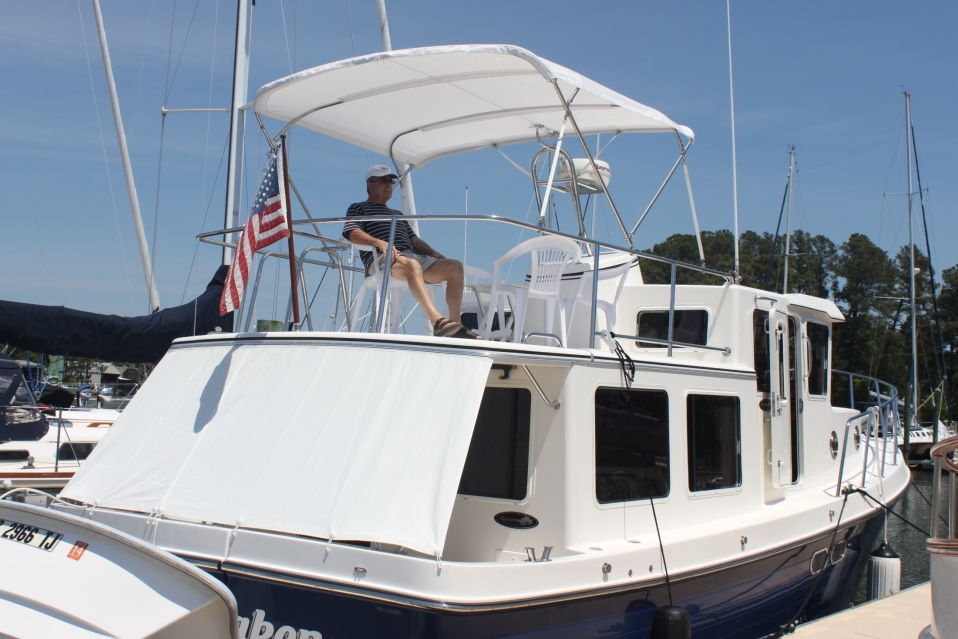
The day opened with more sunshine and almost no wind. I set up the boat in "full dress" with all the canvas, chairs, flags and lines properly placed in anticipation of a day of relaxation. While working, I  made a new friend who came by and hung around hoping I would share a snack with him.

Great Laker in full dress
My new friend


We borrowed the very tired and almost 20-year-old Buick Roadmaster loaner car and drove a curving, two lane, tree-shaded road 3 miles into Deltaville. Here we discovered the J&W Seafood store where Anne bought fresh crab cakes, catfish, shrimp, shrimp salad, and coleslaw. The crab cakes and coleslaw made a wonderful lunch.

Buick Roadmaster
J&W Seafood
The town is very small and peaceful, with less than one thousand full-time residents. But it swells to several thousand during the summer with people looking to boat, fish and enjoy the waters. Surprisingly, there are ten marinas within a few miles of each other here and another ten nearby on the tip of Stingray Point.

The marina has filled up with looper boats coming up from the AGLCA Spring Rendezvous, and I enjoyed sitting on top watching their docking maneuvers. This evening, Jack Dozier, who owns both the marina and Waterway Guides, sponsored a wine and cheese party for the loopers. We joined in and spent time meeting other boaters and learning more about the Chesapeake Bay.